TASK
Read the background information on the fictitious business, Divine Denim Pty Ltd, and then apply the knowledge you have gained in this subject to answer the various questions.
Background
Helen Croker owns Divine Denim, a growing company making made to measure, designer denim jeans and jackets. She uses organic yarn-dyed cotton denim of different weights depending on the garment that she is making. Although she prefers to take the measurements herself, she is now making denim clothes for international customers using the self-measuring system she has developed and put online. For her custom clients, she takes measurements or uses the measurements supplied through her customers’ online application. She uses these measurements to alter the pattern for the design chosen by the client. The pattern is sent to the Cutting Department and the cut material then transferred to the Machining Department.
Helen has recently expanded into a Ready to Wear (RTW) collection which is made in Australia and sold online at a cheaper price point than the made to measure clothing.
Helen designs the RTW clothes and sends the designs to a pattern maker. She previously had two machinists working for her and has just expanded to 8 machinists and a cutter in an expanded factory to manufacture the RTW clothing. One of the machinists uses the riveting and buttonhole machines. Helen has the latest computerised machines enabling her to complete a single setup for all machines from an iPad. She has an administrator who manages the payroll, orders, creditors, delivery and invoicing. An IT expert works 2.5 days a week and manages the company's website, other IT issues and online presence including monthly podcasts. A bookkeeping service is used for basic bookkeeping, GST returns and preparing information for the tax agent.
Helen decided that she needs better cost control and regular information and has asked your firm of accountants, Good Numbers, to provide her assistance to maintain and grow her expanding business.
Question 3 Process costing
As part of your role, you provide Helen with the costs of running her Cutting and Machining departments in July. Only skinny jeans were manufactured in July. All work is commenced in the Cutting Department and output is then transferred to the Machining Department. No direct material is added in the Machining Department but labour and overhead costs, including thread, rivets, buttons, and zippers are incurred uniformly throughout the process. Overhead is allocated based on 125% of direct labour cost. For the Machining Department, the following work in process information for 1 March 2020 is available: 100 units, 75% complete. Costs of this work in process include:
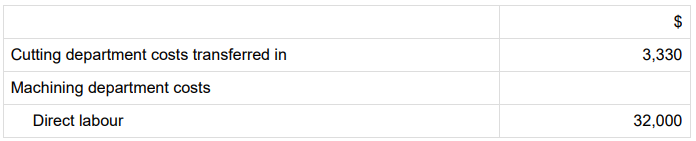
During March 200 units were completed and transferred to Administration for dispatch. Units transferred from the Cutting Department to the Machining Department were charged to Machining at $44.50 each. Direct labour costs in March for the Machining department were $32,000.
On 31 March 35 units were in process in Machining and these were estimated to be 45% complete.
Required:
For the Machining Department calculate, for the month of March, the cost of work completed and the cost of work in process as at 31 March 2020, using:
i. The weighted average cost method, and
ii. FIFO.
Use the example in Figure 7.4 of the text and the information in the Background to Divine Denim, design a job cost record for a pair of custom-made jeans.
Presentation: Use Excel to prepare your answers to parts i and ii. Cut and paste your
spreadsheet results and formula view into your word document. The formula view should include
the column letters and the row numbers.
Students succeed in their courses by connecting and communicating with an expert until they receive help on their questions

Consult our trusted tutors.






 Login | Sign Up