Test 4
Exercise 1
Assume that a firm uses the accrual basis of accounting and recognizes revenue at the time it sells goods or renders services. Indicate the dollar amount of revenue recognized in the month of January. (Each case is independent of the others.)
a. In January, a company sold its product for a sales price totaling $450,000, of which $270,000 was collected in January, $100,000 collected in February, and the remainder in March.
b. A theatrical company sells $600,000 of season tickets to its plays, which the company will perform the second Saturday in each month for 10 months beginning in January. Also, the company sells $80,000 of tickets for January's play.
c. The Laker Gators, a pro football team, receives $6,000,000 as its portion of the gate receipts for the playoffs held in the previous December.
d. Bonilla, Co., an owner of office buildings, collected $1,800,000 in January for office rental fees for the 12- month period, January through December.
e. On January 1, a company loans $300,000 to a customer. The customer agrees to repay the $300,000 plus 12 percent interest (total of $336,000) on December 31.
Exercise 2
Lonski, Inc. began operations on January 1, Year 4. The owners invested $48,000 and the company borrowed $36,000 from a bank. The bank loan is due on January 1, Year 6, with interest at 10 percent per year.
On January 1, the company paid $15,000 for a one-year lease of a building. Also, on January 1 the company purchased a one-year insurance policy for $1,800. The company purchased $80,000 of inventory on account on January 2. On January 10 a payment of $60,000 was made to the supplier. At the end of January, inventory costing $10,000 was still on hand.
During January, cash sales totaled $80,000 and sales to customers on account totaled $66,000. During January, $45,000 was collected from customers who bought on credit.
Other costs paid in cash during January were as follows: salaries, $8,000; utilities, $2,400; supplies, $1,500.
Salaries earned by employees but not paid at January 31 totaled $1,200.
a. Compute Lonski's accrual basis income for January.
b. Compute Lonski's cash basis income for January.
Exercise 3
Assume that a firm uses the accrual basis of accounting and recognizes revenue at the time it sells goods or renders services. Indicate the amount of expense recognized during the month of September in each of the following situations.
a. During September, a wholesale company purchased $1,200,000 of its product for resale. A portion, $250,000, was the cost of goods ordered by their customers in August to be delivered in September. Customers placed orders and received goods with a cost to the wholesale company of $450,000 in September. In September, customers ordered goods with a cost of $225,000 to be delivered in October. The remaining portion of September's purchases was maintained for future orders.
b. A manufacturing firm has two insurance policies covering their property against casualty events. Each policy covers a 6-month period. On August 15, the premium for the first policy, $4,500, is paid to cover the period August 15 through February 15. On September 1, the second policy's premium, $2,880, is paid to cover the period September 1 through February 28.
c. A pro football team incurred in September a cost of $354,000 for an advertising campaign that will produce full-page ads in local papers, as follows: two in September, three in October, two in November, and one in December.
d. A swimming pool company purchased concrete supplies totaling $166,000 in August. At the end of August there were still unused supplies totaling $140,000, and at the end of September there were unused supplies totaling $24,000. The remaining $24,000 was used in October.
e. An accounting firm leases its office space. The annual lease payment of $270,000 was paid on July 1.
f. A cosmetics company bases its sales commissions on a percentage of each sales dollar the sales staff generates. The company pays the commission at the end of each three-month period. In September, the company paid commissions of $105,000 for July, August, and September sales. Sales related to commissions for the 3-month period were as follows: July, $262,500; August, $367,500; September, $420,000.
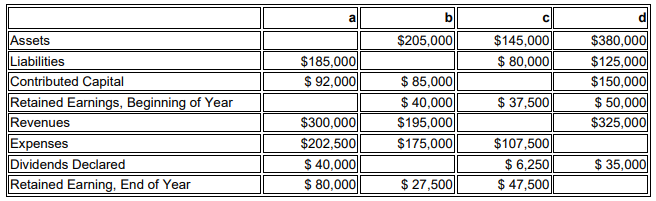
Exercise 4 Compute the missing amounts in each of the following independent cases:
Students succeed in their courses by connecting and communicating with an expert until they receive help on their questions

Consult our trusted tutors.






 Login | Sign Up