15. Continuing the astronomical theme, we note that astronomers don’t work with cartesian coordinates, but with angles. That is, polar coordinates. We will develop a polar equation for conics. In the following diagram of a conic, the distance from the focus F to the point P is r, the angle from the axis of symmetry is θ, the distance between the focus and the directrix is k, and the eccentricity as usual is e.
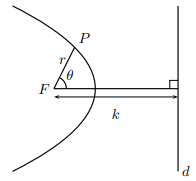
(a) Show that r =
p/1 + e cos θ
, where p = ke.
(b) In the elliptical case (e < 1) find rmax and rmin; the largest and smallest values of r respectively. (Don’t even think about using calculus for this bit.)
(c) Show that p = a(1 − e 2 ).
Hint: use the maximum and minimum values of r that you just found.
(d) If P1 and P2 are two points on the conic whose angles θ1 and θ2 differ by 180◦ , show that the harmonic mean of their respective values of r is a constant (you will need to look up what harmonic mean is).
(e) If a conic has rmin = 10 and rmax = 19, find the eccentricity and semi-major axis.
Students succeed in their courses by connecting and communicating with an expert until they receive help on their questions

Consult our trusted tutors.






 Login | Sign Up