TASK – 2
Introduction
Outdoor landscape watering can comprise a substantial amount of the water used in urban areas, and as summer droughts become more frequent and as urban populations and related water demand increase, more efficient landscape watering practices become essential to sustainable use of water in urban areas. The amount of water used in urban areas for outdoor watering of landscape plants varies depending on the climate. Estimates of the amount of urban landscape water use vary from 9% for Atlanta, GA, to 48% in Salt Lake City, UT (Kjelgren et al. 2000) of total urban water use. The percentage of water used for residential landscapes is even higher. In residential areas, landscape water use averages 40 to 70% of residential water use in the United States (St. Hilaire et al. 2008).
Cool-season turf grass, such as Kentucky blue grass or some fescues, is major component of residential landscaping and is generally a large consumer of landscape irrigation water. Waterefficient landscape practices recommend wise use of turf grass in landscaping and use of efficient irrigation strategies in watering grass areas. Turf grass has some advantages in that it can withstand the stresses of traffic and mowing and it can mitigate high temperatures, noise and dust. Turf is useful in areas that receive high traffic and in recreational areas. Also, many people find turf aesthetically pleasing.
One of the strategies to reduce urban landscape water use is to replace unnecessary turf grass with landscape plants that are adapted to the climate and can survive on the available precipitation in the region. These plants are referred to as xeric, climate-adapted or climate-friendly, and usually need little or no supplemental irrigation to survive. While climate-adapted landscape plants can survive on the natural rainfall, many xeric plants will flourish with more water. As a result, homeowners and landscapers can be lured into watering more to produce more lush vegetation, so educating homeowners about irrigation techniques and management strategies is integral to successful water-efficient landscaping.
For this exercise, we will assume that the xeric, climate-adapted or drought-tolerant species are watered in an efficient manner using drip irrigation systems, which apply water at the base of the plant, and that evaporation from soil moisture is negligible. It should be noted that turf grass is often over-watered, and that it can be used in a water-wise or xeric landscapes, either in small areas, or by using certain species and varieties that have lower water requirements.
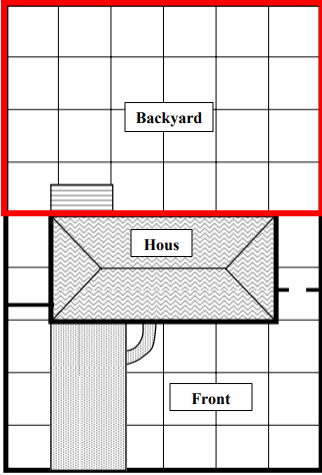
The goal of this task is to compute the water use for the backyard (90 feet x 60 feet ignoring the back deck, outlined in red in Figure 1) of the property shown in Figure 1 for a turf landscape and for a water-efficient landscape of your design. You will calculate the amount of water required for irrigation during the growing season (May–Sept) if the landscape is 100% turf grass. Then you will estimate the amount of water for irrigation of a landscape design of your choice. You may include a combination of turf, very low, low, and moderate water use plants, and hardscape (gravel or rock with no plantings). Your goal is to decrease the landscape irrigation water demand by 40%.
Things to consider as you design your landscape plan:
- Total water savings
o Must save a minimum of 40% water compared with a yard that is 100% turf grass.
- Irrigation efficiency
o Do not design turf grass in small, narrow or oddly shaped areas that are difficult to irrigate efficiently
o Hydrozone your landscape plan. Plan and design your landscape so that high water use plants are grouped together and low water use plants are together.
- Aesthetics
o How much turf vs. how much hardscape? Some studies suggest that people are happy with 25% turf. Is that enough?
o People like color and they like green landscapes.
Part 1 – Turf Irrigation Calculation
In this section you will compute the irrigation needs for a backyard that is 100% turf grass. Use Table 1 in the student worksheet, or perform your calculations with your downloaded data in a spreadsheet.
1. Compute the area of the backyard (ft2)
2. Use the Table 1 on the “Turf Worksheet” for the following calculations:
a. Compute the weekly landscape ET, ETL (inches), for grass assuming a plant factor (PF) of 0.8 (or 80%) for turf (assuming that the lawn is well-watered and is maintained in optimum condition). The ETL is the amount of water that the landscape will transpire. The reference ET, ETO, is given in Table 1.
Weekly Landscape ET = ETL = (ETO x PF)
b. Determine the amount of irrigation (inches) necessary for each week. Subtract the measured precipitation from the landscape ET and apply a 70% irrigation efficiency factor (this accounts for the fact that not all of the irrigation water applied is used by the plant). If P > ETL , then no irrigation is necessary for that week.
Weekly Irrigation Demand = (ETL – P) / 0.7
c. Calculate the weekly irrigation needs in gallons (inches of water applied over the backyard), and the total volume of water applied to the yard over the entire growing season. (1ft3 = 7.5 gallons)
Students succeed in their courses by connecting and communicating with an expert until they receive help on their questions

Consult our trusted tutors.






 Login | Sign Up