Test 3
Exercise 1
Joel Company's balance sheet indicates that the company has $20 million of 8 percent debt and total shareholders' equity of $10 million.
Monika Company's balance sheet indicates that the company has no debt and total shareholders' equity of $30 million.
Assume that both companies are identical in all respects except for the difference outlined above. Both companies report income before interest and taxes of $6,000,000 and the tax rate is 30 percent. Both companies have average total assets of $30 million and sales of $45 million.
a. Compute the Rate of Return on Assets for both companies.
b. Compute the Rate of Return on Common Shareholders' Equity.
c. Explain any difference in the computed ratios for the two companies.
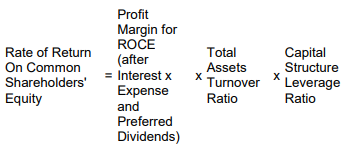
d. For both companies, disaggregate the rate of return on common shareholders' equity into its component parts:
Exercise 2
The Comparative Balance Sheets for Year 1 and Year 2 and the Year 2 Income Statement for Royal Bros., Inc. are as follows:

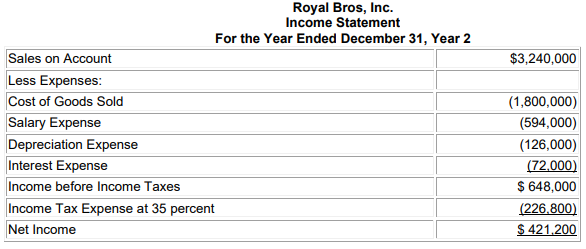
Compute the following ratios for Royal Bros., Inc. for Year 2 or on December 31, Year 2 as appropriate.
a. Current Ratio on December 31, Year 2.
b. Quick Ratio on December 31, Year 2 (inventory cannot be quickly converted to cash).
c. Debt-Equity Ratio on December 31, Year 2.
d. Rate of Return on Assets for Year 2.
e. Rate of Return on Common Shareholders' Equity for Year 2.
f. Earnings per Share of Common Stock for Year 2.
g. Profit Margin Ratio for ROA for Year 2 (before interest expense and related income tax effects).
h. Total Assets Turnover Ratio for Year 2.
i. Interest Coverage Ratio for Year 2.
j. Inventory Turnover Ratio for Year 2.
k. Average Number of Days Inventory on Hand for Year 2.
l. Accounts Receivable Turnover Ratio for Year 2.
m. Average Collection Period for Accounts Receivable for Year 2.
n. Long-Term Debt Ratio on December 31, Year 2.
o. Fixed Asset Turnover Ratio for Year 2.
p. Capital Structure Leverage Ratio.
q. Accounts Payable Turnover Ratio.
r. Profit Margin Ratio for ROCE (after interest expense and preferred dividends).
Exercise 3
This exercise is a continuation of Exercise 2, Royal Bros, Inc.
a. Indicate in the space provided the components of the rate of return on assets for Year 2 from the computations in Exercise 2:
b. Indicate in the space provided the components of the rate of return on common shareholders' equity for Year 2 from the computations in Exercise 2:
Exercise 4
This exercise is a continuation of Exercise 2, Royal Bros., Inc. Given below is information about cost of goods sold, beginning and ending inventories, and average accounts payable for Years 3, 4 and 5:
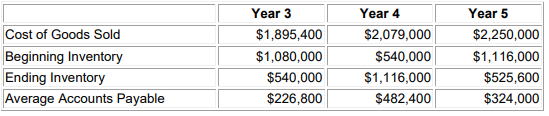
Royal Bros.' Makes it purchases of inventory on credit terms of "net 45 days".
a. Compute the accounts payable turnover for each year.
b. Evaluate Royal Bros.' management of its accounts payable over the three-year period.
Exercise 5
This exercise is a continuation of Exercise 2, Royal Bros, Inc. Given below is information about sales, cost of goods sold, and average inventory for Years 3, 4, and 5:

a. Compute the inventory turnover for each year.
b. Compute the average number of days that inventory is on hand each year.
c. What percentage is cost of goods sold to sales for each year?
Exercise 6 This exercise is a continuation of Exercise 2, Royal Bros., Inc. Given below is information about sales and average accounts receivable for Years 3, 4, and 5. Royal Bros.' credit terms are net 30 days.

a. Compute the accounts receivable turnover for each year.
b. Compute the average collection period for accounts receivable for each year.
Exercise 7
This exercise is a continuation of Exercise 2, Royal Bros., Inc. For the year ending December 31, Year 2, the company reported current assets (Cash, Account Receivable and Inventory) totaling $1,620,000; current liabilities (Accounts Payable) of $680,400; and a current ratio of 2.38 ($1,620,000/$680,400).
a. Assume that, at the end of Year 2, the company failed to record a credit purchase of inventory in the amount of $225,000. What would have been the company's current ratio at December 31, Year 2 if it had correctly recorded the credit purchase of inventory on December 31, Year 2 (ignore income taxes)?
b. Assume that, at the end of Year 2, the company recorded a $270,000 credit sale that it should have recorded as a Year 3 sale. Also assume that the December 31, Year 2 inventory of $1,080,000 correctly includes the cost of the inventory item sold for $270,000 in Year 3. What would have been the company's current ratio on December 31, Year 2 if it had correctly recorded the credit sale as a Year 3 sale (ignore income taxes)?
Students succeed in their courses by connecting and communicating with an expert until they receive help on their questions

Consult our trusted tutors.






 Login | Sign Up